Hi, I’m Tanay, and here’s how I think.
I welcome you to take a deep dive into my thinking and design process. This involves psychology, philosophy, music, and lots of storytelling.
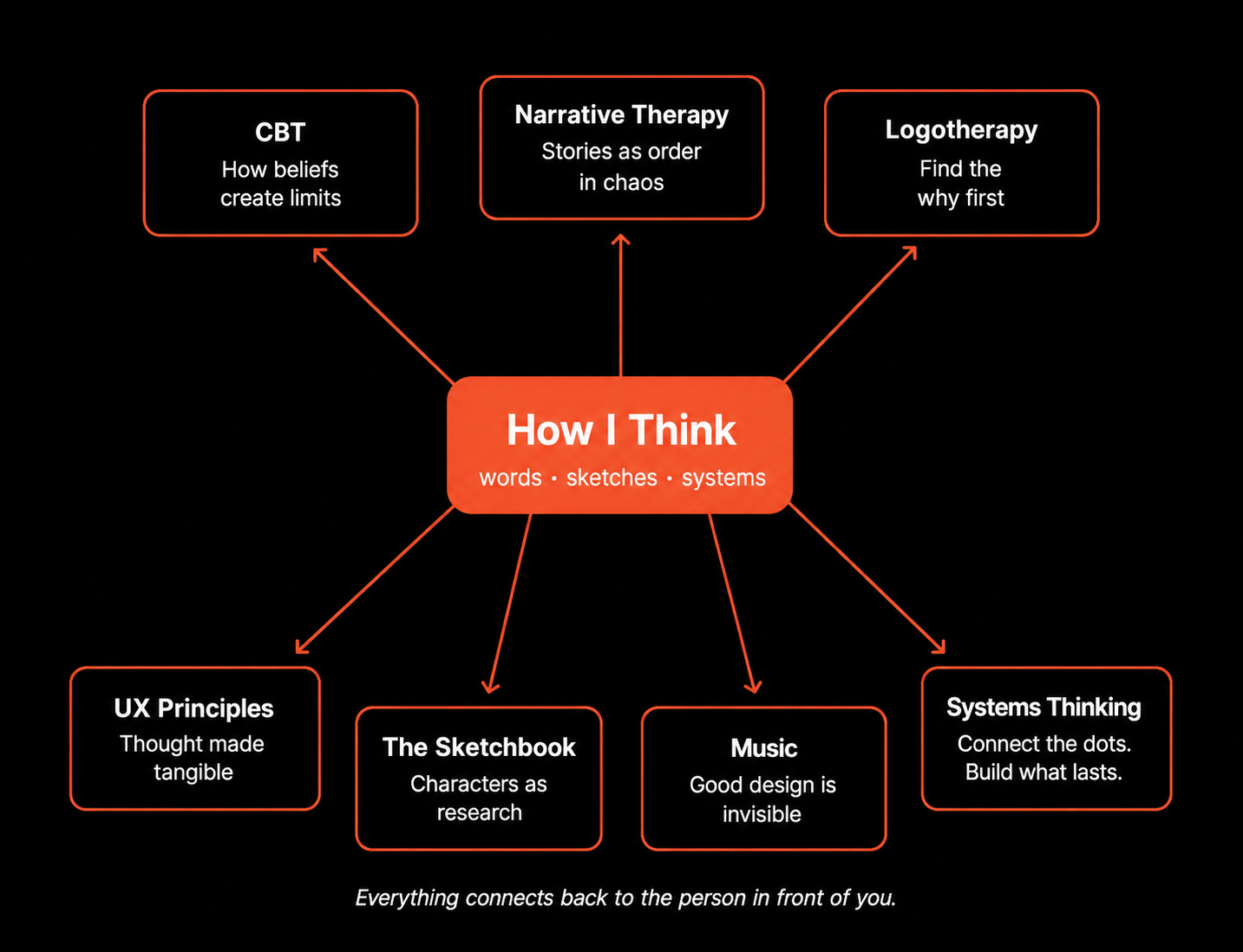
Visualization
I keep a sketchbook. Not for reference, and not for finished work. It's where characters live before they have names.
I draw at cafes and pubs, usually in ink, usually in one sitting. When someone nearby looks curious, I turn the book toward them and ask two questions: what do you think this person is like, and what would you call them?
What happens next is rarely about the drawing.
A woman in Bali looked at an armoured figure with a masked face and started talking about her father. A man named Igor saw himself in a character I had already, without knowing him, named Igor. Someone else gave a wandering rogue the name Pierre and then explained, unprompted, why they'd chosen it. The character became a mirror, and the stranger became a collaborator.
This is how I think about personas. Not as deliverables, but as invitations. A well-drawn character — in any medium — creates enough specificity to feel real and enough space for someone else to project their own experience into. That tension between the specific and the universal is where empathy lives. It's also where good UX writing lives.
The story I'm building these characters for is called Remembrance. It follows a man who can see through the AI-generated narratives of his time, and fights to preserve what makes us irreducibly human: our stories. The irony is that I've been researching that story the same way I research a voice and tone system. By sitting with people, asking open questions, and listening for what they reveal when they think they're just talking about a drawing.
The characters you see here are not finished. Neither are the ideas behind them. But the process of making them has taught me more about how people understand themselves through narrative than any framework I've read.
That's the methodology. The sketchbook is the research tool.
Schools of Thought
I don't follow frameworks the way you follow instructions. I use them the way a musician uses scales — as a structure that eventually disappears into the playing.
Cognitive Behavioural Therapy
CBT gave me a lens for something I kept noticing: people are rarely stopped by the actual problem. They're stopped by the story they've constructed around it. Core beliefs, cognitive distortions, automatic thoughts — these are the invisible architecture that makes someone feel permanently stuck when the door has been unlocked the whole time. I use this lens in coaching, obviously. But I also use it in design. When a user abandons a flow, gives up on a form, or describes a product as confusing, I ask the same question I ask a coaching client: What belief about themselves or the system made this feel impossible? The answer is rarely the button. It's seldom the copy. It's something older than both.
Narrative Therapy
Stories are not just how we communicate. They're how we decide who we are. Narrative therapy taught me that the chaos of a life only becomes a life when someone imposes a story on it — and that the stories we inherit are not the only ones available to us. In design and content, this is the most powerful tool I know. When copy resonates, it's not because it describes a feature accurately. It's because it reflected the user's story back to them in a way that felt true. The best content doesn't tell people what to think. It helps them remember something they already knew.
Logotherapy
Viktor Frankl built his entire philosophy in a concentration camp, which is worth sitting with before you apply it to a product brief. His central argument is that meaning precedes motivation — that if you understand the why, the how stops being an obstacle and becomes a path. I use this when I'm stuck, when a client is stuck, and when a product is stuck. Not "what do we need to build" but "what does this need to mean to the person using it." The answer to that question reorganises everything else.
UX Principles
The others are about the interior life of a person. UX is where that interior life meets the world. I think of it as the discipline that blurs the line between thought and thing — the place where human psychology becomes a system that other humans can navigate. When it works, it disappears. The interface becomes invisible. The words become invisible. The user just moves through the experience the way water moves through a good pipe, without ever thinking about the pipe.
I'm also a musician. I play fingerstyle classical guitar by ear, which means I've spent a lot of time learning that the notes are not the music. The music lives in the space between them — in the pause, the breath, the decision not to play something. Good design works the same way. The best interface copy I've ever written is the copy I decided not to include. The most important word in a conversation is sometimes the one you wait for the other person to say themselves.
That's the thread connecting all of this. CBT, narrative therapy, logotherapy, UX — they're all different maps of the same territory. The territory is a person, trying to find their way through something difficult, hoping the world was designed with them in mind.
Simple ideas
Through every step, we've focused on staying true to our values and making space for thoughtful, lasting work.
Lasting impact
We build with clarity, act with integrity, and always stay curious.